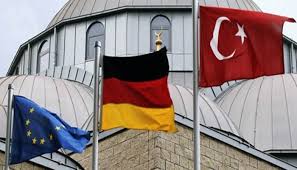
Berlin wants to sever the financial and institutional ties between local Muslim communities and the Turkish government as part of a bold campaign to help German Muslims develop a homegrown version of Islam. “What we need now is an Islam for German Muslims that belongs to Germany,” Markus Kerber, the top civil servant in the German interior ministry, said in an interview with the Financial Times.
“That does not mean that we want to develop a new theology. It means that German Muslims have to decide: what kind of Islam do we want here?” Mr Kerber, who is the official in charge of relations between the government and the country’s 4m-strong Muslim community, added: “Our goals are: to reduce foreign influence — both financial and personal — on Germany’s Muslim community; to ensure that imams preaching in Germany are trained in Germany; and to ensure that Muslims are better integrated in German society when it comes to issues of everyday life.”
Integrating the German Muslim community and combating Islamist extremism have emerged as important challenges for policymakers in Berlin. Part of the urgency is linked to the 2015-16 refugee crisis, which led to the arrival of more than 1m migrants from Muslim countries such as Syria and Afghanistan.
At the same time, a marked rise in political tensions between Berlin and Turkey has tested the loyalties of the German-Turkish community, unsettling an established Muslim community that has made Germany its home since the early 1960s. Turkey continues to play an outsized role in the affairs of Germany’s Muslim community, thanks largely to the Turkish-Islamic Union for Religious Affairs, or Ditib, the largest Islamic organisation in the country. Ditib, which is a branch of Turkey’s own state directorate for religious affairs, runs 900 of the 2,400 mosques in Germany.
Its imams are sent from Turkey, mostly preach in Turkish and are paid by the Turkish government. “The Turkish government has to accept that the days when they had total control over German mosques run by Ditib are over,” Mr Kerber said. “I told officials in Ankara: your Turks are also our Turks now. Get used to it.” German Muslims, he added, had the right to be preached to in German and to have imams who were familiar with the realities of daily life in Germany.
“Take the question of whether piercings and tattoos are compatible with the teachings of the Koran. If an imam cannot provide answers to questions like these then there is a real danger that young Muslims will turn to an imam on the internet — and that can quickly lead into dark waters.”
Source: FT